Google Sheets Gantt chart template: plan work on a real timeline
Turn tasks, owners, dates and status into a timeline that the team can update.
 Written by PhilisPublished June 11, 2026Last updated July 27, 202611 min
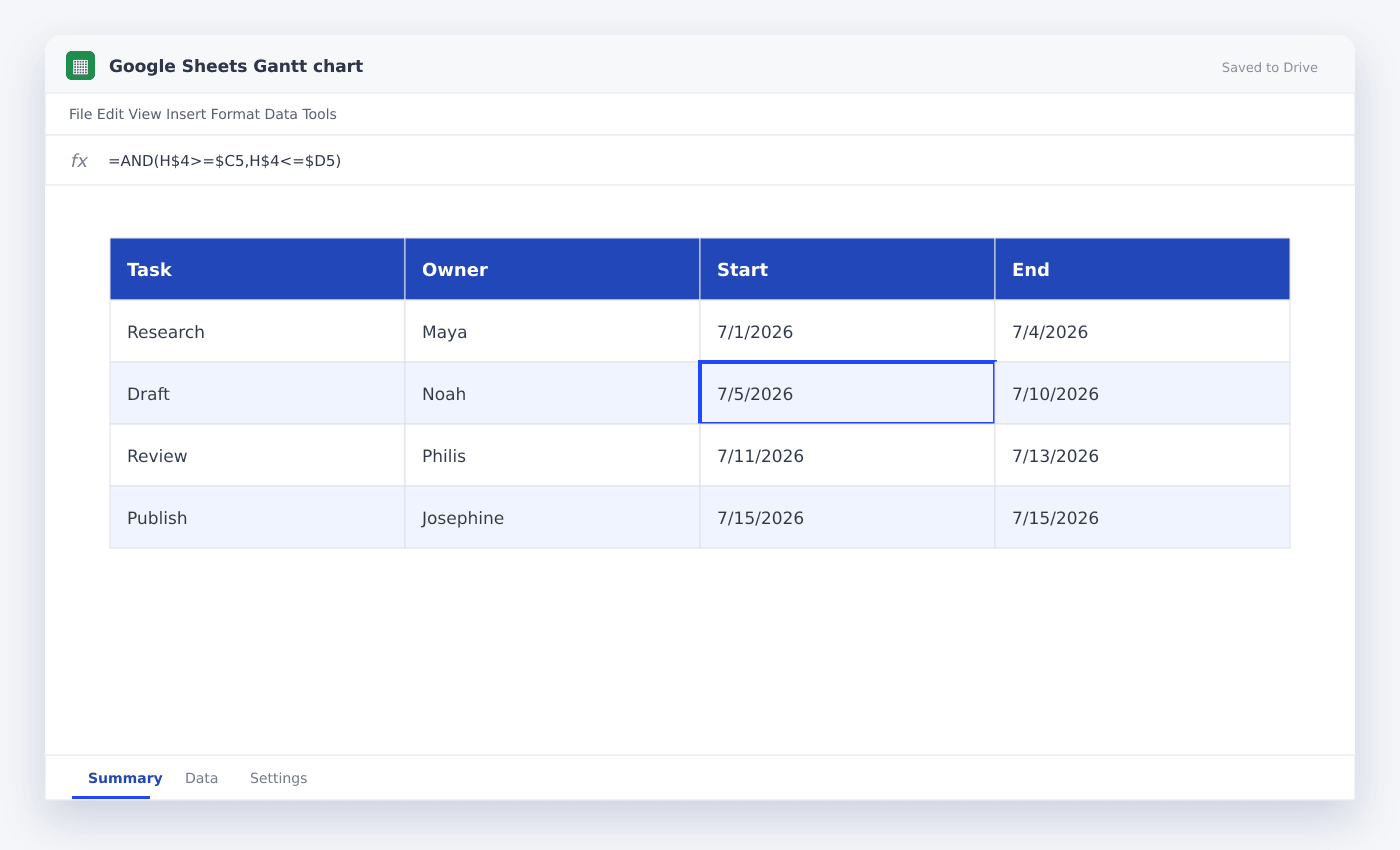
Create one row per task with start and end dates, place daily or weekly dates across the header, and use conditional formatting to fill cells whose header date falls inside each task period.
Before you build a working Gantt chart, set up a clean source range and one result you can check by hand. That gives you a known answer before the sheet grows.
This article shows how to build a working Gantt chart. The sample sheet uses ordinary rows so you can copy the method into an existing file without rebuilding everything.
Google Sheets Gantt chart template: plan work on a real timeline
- 01Make a safe copy
Duplicate the source tab or file before changing formulas, ranges or formatting.
- 02Set up the source rows
Add the fields needed to build a working Gantt chart. Keep one record on each row and one field in each column.
- 03Add the method
Enter =AND(H$4>=$C5,H$4<=$D5) in a test cell and check its first result.
- 04Check a known case
Pick one row whose answer you already know and compare it with the sheet result.
- 05Test the awkward rows
Check blanks, zeros, repeated entries and one row that should not match.
- 06Apply it to the full range
Copy the formula or rule only after the sample cases return the expected result.
Set up the sheet for Google Sheets Gantt chart
Keep the source table rectangular. A single header row, no merged cells and consistent cell types make the work much easier to check.
Place settings, fixed rates or allowed labels on a separate tab. Name them clearly so another person can read the file without tracing every cell.
- Use true date cells
- Keep one row per task
- Add a status dropdown
- Mark overdue work separately
Check the first result before copying it
A result that looks plausible can still be wrong. Work through one row manually, compare it with the Sheet and check every referenced cell.
Next, test a blank row and an unusual row. These two checks catch many range, type and copied-reference mistakes before they spread.
=AND(H$4>=$C5,H$4<=$D5)Keep the file reliable as new rows arrive
Leave input columns visually separate from calculated columns. Protect formulas when several people edit the same file, and keep dropdown lists or settings outside the main table.
Add a short check near the result: row count, unmatched count, last refresh time or a manual spot check. The right check depends on the job, but it should make a bad update easy to notice.
Questions people ask
Can Google Sheets create a Gantt chart?+
Yes. A date header plus conditional formatting works well for a simple project timeline.
Should the timeline use days or weeks?+
Use days for short projects and weeks for work that runs across several months.
How do I mark progress?+
Add a percent-complete column and use a second formatting rule or progress bar.
More from SheetSteps

Google Sheets budget template: a practical monthly system
10 min · Templates
Google Sheets invoice template: build one that tracks payment
9 min · Templates

How to build a Google Sheets dashboard people can read
11 min · Data & charts